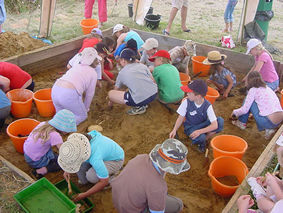
Phase Six of the Dovehouse Excavations began in August 2010. So far dozens of children have worked enthusiastically to uncover an amazing range of finds and features in what appeared to be an abandoned C17th graveyard.
Dumped in it were some ornamental bricks and a huge broken vase probably from the Walled Garden. Another was also found and their pedestal bases obviously thrown away when they were broken. The bricks represented different parts of an ornate brick house with pillars, window mullions and moulded decorations probably of the C16th or C17th. Some were numbered.
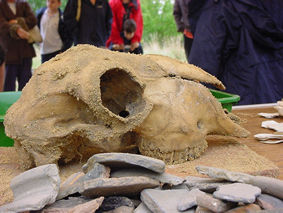
A number of floor surfaces and brick foundations were uncovered and it seems likely that they were the base of funerary monuments next to the graves of which there were three. One was empty of human remains but a sheeps skull was discovered much the same as last year. Evidently this had been a good place to dispose of unwanted animals.
The upper body had
no skull, one humerus was missing and the bones were highly jumbled about.
The mandible, clavicles and pelvis told us it was a man and the teeth told
us it was an adult who ate a good diet. No fillings, plaque or cavities.
The wisdom teeth were not erupted so probably someone under 30-35. The bones
were in good condition.
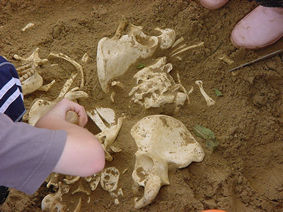
In both graves the bones had been covered over with peg tiles and it was obvious that the brick coffins had been dismantled. There was evidence of wooden caskets from coffin handles and large nails.
Evidently the ground level had been massively reduced and whatever building that was close by dismantled.The disturbed bones were then laid back roughly where they came from minus a few - perhaps having been smashed by accident.
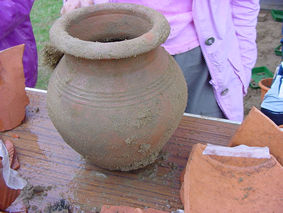
A complete roman style pot was discovered in very good condition. We also found a single gold coin. The coin is not roman and most of the other coins recovered were mediaeval of the C12th and C13th.
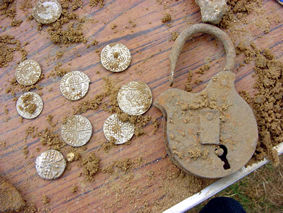
Lastly we found a large number of padlocks and pintle hinges and I get the distinct impression that a large stables was dismantled and dumped here in the early C20th.
Barry Hillman-Crouch
MStPA DipFA BScHons HND.


